An elder of IFEW

Mr Ali Hussain Siddiqui

Entomologist, lecturer and a devoted elder of the community, who gathered with his family at the weekly Usrah until his last days.

  • 1922 to 2011
  • Arrived in Australia 1981
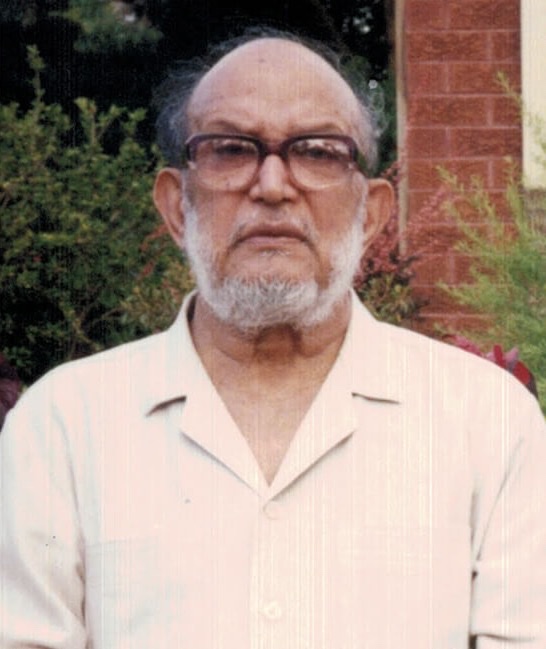
Portrait of Mr Ali Hussain Siddiqui in his later years

His life in brief

A quest for knowledge, and a family that stayed together

Mr Ali Hussain Siddiqui was an entomologist by profession. He was born in British India, spent his working life in East and West Pakistan, and migrated to Australia with his family in 1981, where he became a devoted elder of the community.

His life took in family history, education and profession, and a journey from India to East Pakistan (now Bangladesh), then West Pakistan and finally Australia. He was blessed with a long life, full of trials in his early and middle years, and spent his old age happily surrounded by family, friends, carers and community.

Along with Dr Qazi Ashfaq Ahmad, whose sister he married, he was a pillar of the family from which IFEW grew. Read about Dr Ahmad.

At a glance

Born
3 January 1922, Anwayan, District Ballia, Uttar Pradesh, India
Passed away
29 July 2011, Bankstown Hospital, Sydney
Profession
Entomologist and lecturer; plant protection and pest control
Studied
Aligarh Muslim University: BSc 1945, MSc in Zoology (Entomology) 1949
Lived in
India, East Pakistan (Bangladesh), Pakistan and, from 1981, Australia
Family
Wife Akhtar Bano (1949 to 2005), their children and a large extended family

His story

From Ballia, to Dhaka, Karachi and Sydney

1922

Born in Anwayan

Ali Hussain Siddiqui was born on 3 January 1922 in the village of Anwayan, near the town of Bilthra Road, in District Ballia in the east of Uttar Pradesh, India. He was generally considered to be four years older than his officially recorded age.

1922

A family of landowners

The Siddiqui family trace their origins to the first Caliph, Abu Bakr Siddiq (may Allah be pleased with him). One of his descendants, Sheikh Azeemullah Siddiqui, known as Sheikh Paharh (“Sheikh Mountain”) for his extraordinary height, migrated from Hijaz, Arabia, to India and settled in Harhans, on the borders of Bihar and UP, in 1361 CE. The family history from 1361 to 2005 is documented in the book Tareekhul Harihans mae Khandani Shajra, updated and published in Delhi in 2005.

Ali Hussain was born into the extended zamindar (landowning) Siddiqui family. His great-grandfather had settled in Anwayan and built a huge family complex there, with reception lounges, a madrassa, a masjid, living quarters with courtyards and gardens, and stables. He was the second eldest in a family of two sons and four daughters, and lost his mother at an early age.

He grew up in a time of great change: the breakdown of the feudal system, the end of the British Raj, the fight for independence and the partition of the country into India and Pakistan.

1940–49

Seeking higher education

Ali Hussain realised that the zamindari system was breaking down fast and was not interested in the traditional family occupation. He was keen on higher education, not only for himself but for the younger generation of his large extended family.

After high school at George Islamia College, Gorakhpur, in 1940, he moved to Aligarh Muslim University, where he spent the next nine years: Intermediate in 1943, a BSc in 1945 and an MSc in Zoology, specialising in Entomology, in 1949. He also earned a certificate of proficiency with the Indian Air Training Corps in 1944. When support from home was delayed, he gave tuition to support himself. He encouraged a number of his cousins to seek higher education at AMU and other institutions in India and abroad.

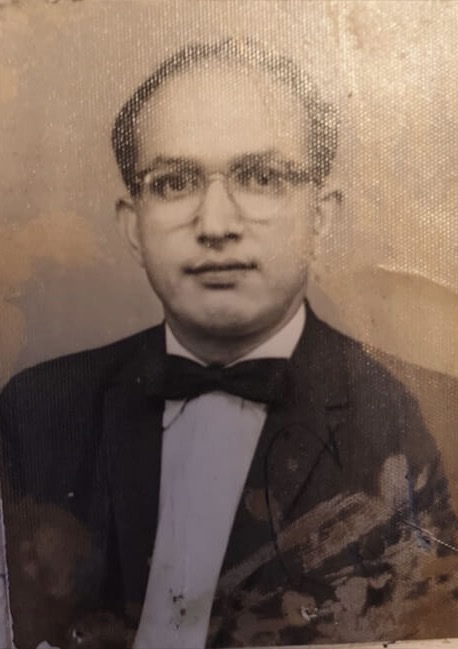
Ali Hussain Siddiqui as a young man in a bow tie and glasses
As a young man.

1949

Friendship and marriage

After graduating he worked as a Lecturer in Biology at George Islamia College, Gorakhpur, from 1949 to 1950.

At Aligarh he met a bright young man completing his engineering degree, Qazi Ashfaq Ahmad. The two became friends, and arranged marriages on a reciprocal basis: Ali Hussain’s second sister, Jamal Ara, married Ashfaq, and in 1949 Ali Hussain married Ashfaq’s elder sister, Akhtar Bano. The two had become orphans very young and grew up with their grandfather, a retired magistrate, and their aunt in Mohammadabad Gohna.

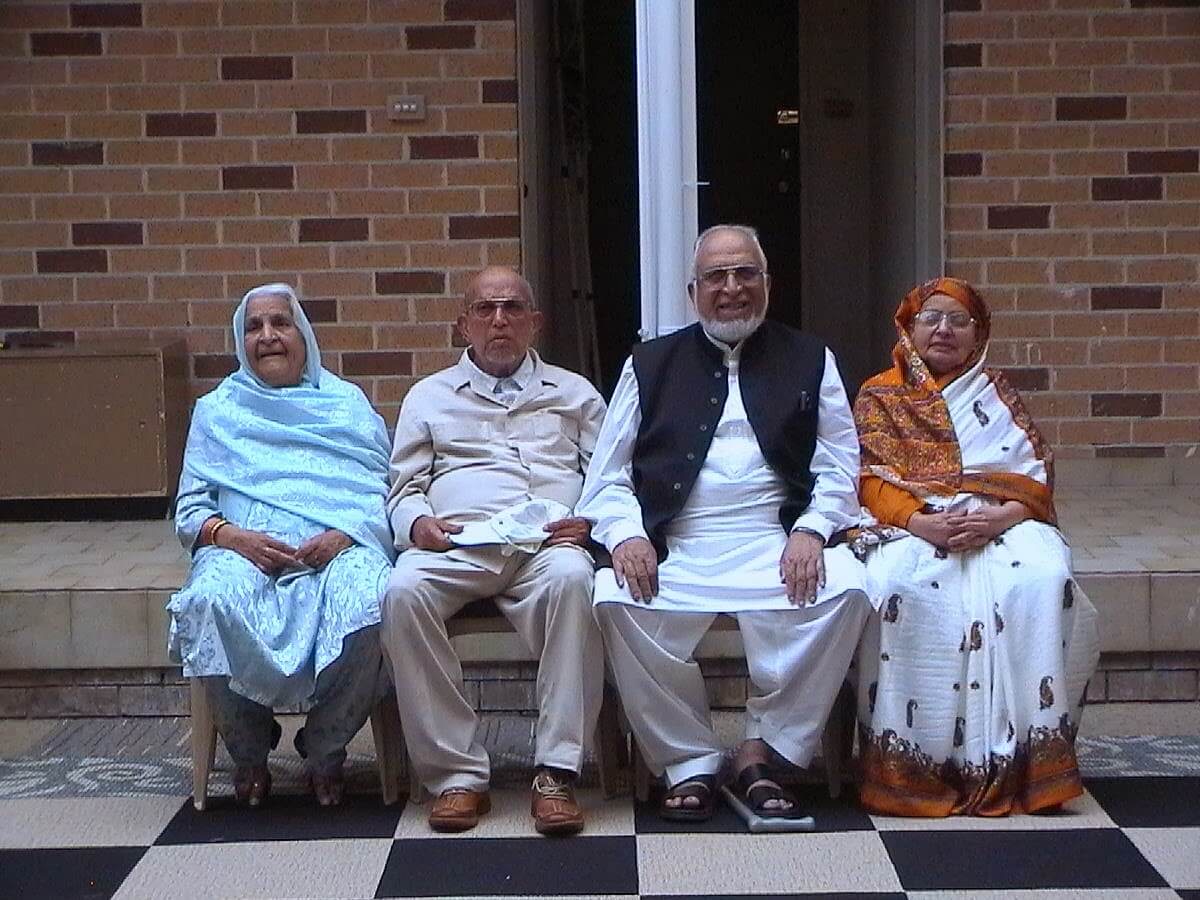
Two elderly couples seated together in front of a brick wall
From left: Akhtar Bano Siddiqui, Ali Hussain Siddiqui, Ashfaq Ahmad and Jamal Ara Ahmad, 2006.

1951

Plant protection in East Pakistan

In 1951 Ali Hussain migrated to East Pakistan (now Bangladesh), joining the Department of Plant Protection in Dacca (Dhaka). He rose from Assistant Entomologist (1951 to 1957) to Assistant Aerial Pest Control Officer (1957 to 1971), and Assistant Director, Plant Protection (1962).

He specialised in protecting crops from pests, testing different insecticides and spray systems in the laboratory and in the field, and aerial spraying of large areas of farmland in both East and West Pakistan. He published five research papers in scientific journals.

1950s–60s

Booa, the heart of the household

These were years of trial for the family, in a new country and without the support of their extended family. They were helped enormously by a Bengali woman, Rabia Khatoon, whom the children called Booa. She looked after the household as governess, feeding the children and teaching them life skills, and sacrificed her own ambitions to do so.

When the family moved to Karachi, she left her country, her people and her culture to keep caring for them. Ali Hussain and his family developed great respect and love for her and were forever indebted to her. She later married in Lahore, and lived happily until she passed away in 1998. Many in the Australian family visited her there over the years.

1961

A year in Texas

In 1961 he spent a year at the Agricultural & Mechanical University and the Rice Pasture Experimental Station of Texas, USA, and received a training Certificate of Achievement.

1971

Karachi, West Pakistan

At the beginning of 1971 Ali Hussain moved to Karachi, in West Pakistan. From 1973 to 1981 he worked as Deputy Research Entomologist with the National Agricultural Research Council (NARC), Government of Pakistan.

1975

Two families, joined again

Meanwhile Ashfaq Ahmad had migrated to Sydney in 1971 and decided to make Australia his home. He remained concerned about his only sister’s family, and the two men proposed a second set of reciprocal marriages between their families. The children agreed, and the weddings were held in Sydney in 1975, where Ali Hussain and Akhtar Bano stayed for a few months.

1981

A new home in Australia

In 1981 Ali Hussain’s entire family migrated to Australia. The Ahmad and Siddiqui families flourished here, gaining education, finding jobs, establishing businesses and buying homes, and multiplying into a clan of more than 75 people and counting.

Above all they built close family relationships under the guidance of the first generation of elders, meeting together every week and sharing their happiness and their sorrows for the next 40 years.

1981–2011

Community, Usrah and AMU

The family took part in many community organisations and established institutions for the promotion of Islam, Muslims, the Urdu language and the Aligarh movement. Ali Hussain was passionate about serving the AMU Alumni of Australia: he attended its functions and even made halva with his own hands to sell and raise funds for the AMU scholarship project.

He regularly attended the weekly Usrah study circle at Dar-ul-Islam in Bonnyrigg, as well as family and community functions, until his last days. In his old age he felt deeply satisfied with his family’s achievements, and proud of his children’s business ventures and of the higher education of the third generation. His training, guidance, blessings and above all his duas stood behind that success.

2005

Losing his wife

His wife, Akhtar Bano, passed away in 2005 after a short illness, and was buried at Liverpool Cemetery.

2011

Passing away

In mid-2011 Ali Hussain became ill and went to hospital, where members of his extended family, of the second and third generations, spent time with him on a roster, looking after him and strengthening their bonds with him.

He passed away at around 6 am on Friday 29 July 2011 at Bankstown Hospital. His janaza was held after Juma at Lakemba Mosque, led by Sheikh Tajuddin al-Hilaly, and joined by his large extended family, friends and hundreds of Muslims. He was buried that afternoon at Liverpool Cemetery. Inna lillahi wa inna ilayhi raji’un.

Profession

A career in plant protection

Positions held

  • Lecturer in Biology, George Islamia College, Gorakhpur, 1949 to 1950
  • Assistant Entomologist, Department of Plant Protection, Government of Pakistan, 1951 to 1957
  • Assistant Aerial Pest Control Officer, 1957 to 1971
  • Assistant Director, Plant Protection, 1962
  • Training at the Agricultural & Mechanical University and the Rice Pasture Experimental Station, Texas, USA, 1961
  • Deputy Research Entomologist, National Agricultural Research Council (NARC), Government of Pakistan, 1973 to 1981
  • Author of five research papers in scientific journals

Remembered

A long life, well served

Ali Hussain Siddiqui was blessed with a long life of almost 93 years. It was full of trials in his early and middle age, but he spent his old age happily served, loved and surrounded by his close family, lovely friends, dedicated carers and an active community, in a great country.

May Allah grant him jannah in the hereafter, and make us able to cherish his memories and keep remembering him in our duas. Aameen.

This page draws on A tribute to Mr Ali Hussain Siddiqui by Zia Ahmad OAM, Australasian Muslim Times (AMUST), August 2021. Photographs courtesy of AMUST.

Carrying it on

The circle he joined still meets.

Every Sunday, IFEW’s Family Usrah gathers in Bonnyrigg. Come and join us.